
AireFest 2026 review: health tech without the sales pitch
No stands, no pitches. See how AireFest 2026, our free health tech festival in Leeds, put patients, NHS leaders and real conversation first.

What happens when you strip out the sales pitch: An inside look at how AireFest made room for the conversations healthtech needs.
Nine months ago, we set out to build a health tech conference that was different. On 9th July, in 32-degree heat, we found out whether we had succeeded.
If you’re familiar with the health tech conference circuit, you know the usual drill: rows of exhibition stands, polished sales decks, and plenty of pitches. Innovation gets talked about in the abstract while the people who deliver care sit in rows and nod politely.
We wanted to try something else. No stands. No sales pitches. Just real, honest conversations between the people who shape healthcare.
All rounded off with a party on the rooftop… it’s called AireFest for a reason, after all.
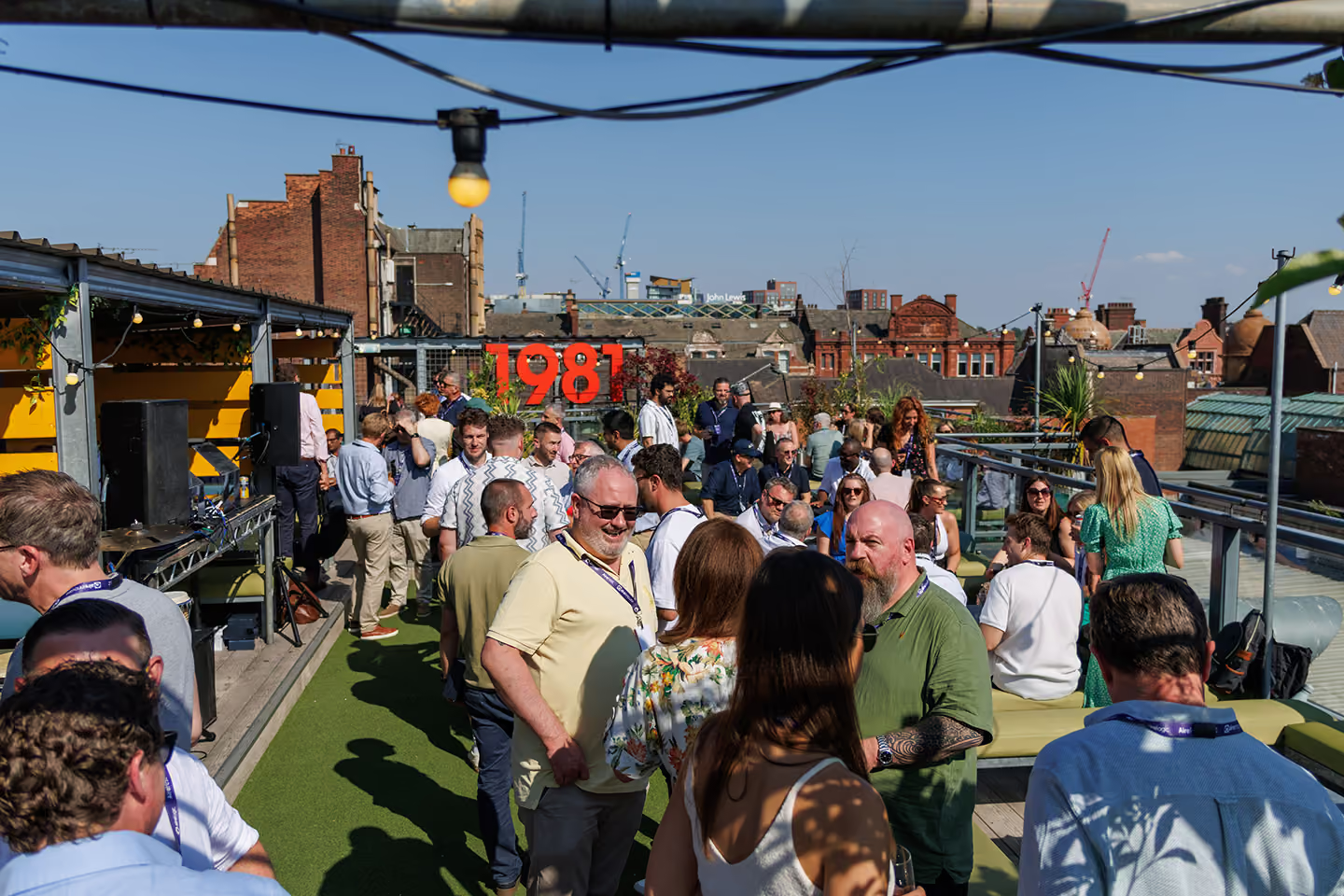
And that’s exactly what it felt like. A festival. A day of interactive workshops, panels, and seminars across three unique zones, ending with a barbecue, a live DJ set, and a sunset over Leeds.
Free to attend, and full of the brightest minds in the UK health sector.
The Innovation Zone: Big questions for the bigger picture.
The Innovation Zone was where the day started and ended on a single question: are we building the right thing, for the right people?
Victoria Betton and our own Vikki Foxley-Sayles opened with a workshop on user-centred design that made the room think hard, and at times, squirm a little. It set the tone for the whole day: most digital projects in health don't fail because the technology is wrong. They fail because nobody properly understood the people who were meant to use it.
The afternoon then turned the theory into practice with our Neighbourhood Health Dragon’s Den, led by Dr Gurnak Singh Dosanjh, Amanda Jackson, Dr Nabeel Arshad and Hannah Al-Othman, and Dr Harry Thirkettle. Teams were asked to design a response to a single question: what would you do with £150,000 to improve neighbourhood health where you work? The winning team would direct a £5,000 donation to a charity of their choice.
We'd hoped it would be interactive. We hadn't quite expected the buzz. Four teams pitched genuinely good, genuinely different ideas, and the panel had a difficult decision to make.
The winners chose to donate to EdShift, whose Little Voices programme uses play-based dramatherapy to support children affected by domestic abuse. That felt exactly right for the day.
The Collaboration Zone: Shared solutions for shared problems.
The Collaboration Zone was, unsurprisingly, all about collaboration. We put clinicians, technologists, and NHS leaders in the same room, on the same problems, at the same time.
Ian Gargan (CEO of PHIN) and Aire Logic's Andrew Martin opened with a discussion on whole-practice data across the public and private sectors, marking the UK private healthcare sector's recent milestone on transparency and what it means for patient choice.
That was followed by Where's the patient? — a fireside chat between Mark Duman and Chris Carrigan (use MY data) that put the patient voice back at the centre of the data conversation.
The afternoon was given over to a masterclass on EPR implementation with Michelle McDermott (Humber Health Partnership), Aire Logic's Mike Hardman, and Sofia Fontes (CNIO, The Royal Wolverhampton NHS Trust). It's a topic that could easily have stayed technical, but Sofia's contribution grounded it firmly in the clinical reality of getting an EPR over the line.
All three sessions taught the same lesson: the answers aren't in any one part of the system. They're in what happens when data holders, clinicians and delivery teams stop working around each other and start working together.
Judging by the conversations in the room, we’re on our way there.
The Community Zone: Real conversations about real people.
True to its name, the Community Zone was where the day's conversations kept the patient nearest to the surface, whether the topic was systems, mental health, or AI.
"It's a very dry subject, but actually, it was a really interesting conversation" remarked Prof. Stella Vig on her own panel on the Single Patient Record. And she was right, it turned into one of the most engaged sessions of the day. Together with Joseph Waller, Damian O’Boyle (Healthy.io) and Kyle Yeldon (NASGP), they agreed that a patient should never have to think about interoperability. What they should see is their data working quietly in the background, supporting their care, personalising it, and helping keep them out of the complications that come further down the line.
Duncan Pearse (CEO of Northpoint) followed with Juggling the challenges of a mental health pathway - and yes, before you ask, there was actual juggling. Part workshop, part problem solving, part circus act. All one reminder that the systems we design end up shaping some of the most vulnerable journeys through health and care.
After lunch, Laura O'Riordan (CEO of Doctor Care Anywhere) came ready to shift some thinking, digging into what becomes possible when the wall between NHS and private sector data comes down. Then to close the day, Alwyn Kotze, Dr Mike Odling-Smee and Lauren Harkins (Head of AI Strategic Alignment, NHS England Joint Policy Unit) unpacked what AI in surgery really looks like. Together they took the Community Zone beyond the headlines and into the operating theatre, talking candidly about what’s real, what’s still coming, and what the NHS has to get right.
The Rooftop: Heroes and headliners.
By 4pm, it was time for the Aire-festivities to begin…
32 degrees, a BBQ, an open bar, bongos, beats, and a view of the Leeds skyline that did a lot of the work for us.
But even as the party started, the spotlight was still shining on the people leading health and care. It was time for the Unsung Heroes Awards.
The NHS runs on countless people behind the scenes whose names don’t always make it to a conference programme. This was our chance to celebrate these people, and one of our proudest moments of the day.
So thank you again to our Unsung Heroes: Tom Knight, a paediatric ward chef at Alder Hey, who taught himself carb-counting so children with diabetes could start insulin dosing sooner. The Integrated Community Children's Nursing Team, also at Alder Hey, keeping some of the UK's most vulnerable children cared for at home. Ashley Harris, a lead engineer at NHS England who quietly fixes what no one else can. Dr Sunil Daga at Leeds Teaching Hospitals, whose kidney research is matched by his advocacy for the communities the system too often overlooks. Alex Hernandez at Health Innovation North West Coast, connecting the people and ideas that wouldn't otherwise find each other. Sam Norris of BHA for Equality, who has brought 34 people living with HIV back into care by refusing to see anyone as their diagnosis. And Amanda Jackson, Associate CCIO at Leeds Community Healthcare, whose Digital Inclusion Hubs are changing real lives, one conversation at a time.
By the time the sun was setting, it was easy to see that we’d built the kind of healthtech event we’d always wanted to attend. One that’s honest and open, filled with a community that cares, putting patients before sales pitches.
What the day taught us.
Strip out the stands and the sales pitches, and there's room for the conversations health tech actually needs.
We asked the room to participate, to challenge, to be honest about what wasn't working, and they did. The day taught us this: If you build a conference around passive consumption, you get passive attendees. Build one around conversation, and you get a community.
Some of the best conversations at AireFest weren't in the sessions. They were on the rooftop, in the corridors, in the queue for the barbecue, between people from across the sector who share the same goal of making healthcare better, but don’t often get the chance to do it side by side.
What's next?
AireFest 27 is already in the works. We'll be back with more speakers, more hot topics, and (fingers crossed) more free drinks.
To everyone who participated, panelled, and played along with us: thank you. The future of health and care won't be shaped in isolation. It'll be shaped in rooms like this, by people like you.
You gave us something we're already proud to build on.
See you in 2027.
